Blind on purpose: equilibrium as a conceptual filter in economics

A couple of years ago, I came across this article written in The Huffington Post by economist and game theorist David Levine. It carried the provocative title "Why Economists Are Right," and argued back against all those who were then criticizing economics -- especially the rational expectations assumption -- in the aftermath of the financial crisis. Levine's article is delicately crafted and sounds superficially convincing. Indeed, it seems to make the rational expectations idea almost obvious. His argument is a masterpiece of showmanship in the manner of Milton Friedman -- its conclusion seems unavoidable, yet the logic seems somehow fishy, though in a way that is hard to pin down.

The most notable passage in this sense is the following:
In simple language what rational expectations means is "if people believe this forecast it will be true." By contrast if a theory is not one of rational expectations it means "if people believe this forecast it will not be true." Obviously such a theory has limited usefulness. Or put differently: if there is a correct theory, eventually most people will believe it, so it must necessarily be rational expectations. Any other theory has the property that people must forever disbelieve the theory regardless of overwhelming evidence -- for as soon as the theory is believed it is wrong.
Seems convincing, doesn't it? Or at least almost convincing. Is this the only claim made by the rational expectations assumption? If so, maybe it is reasonable. But there's a lot lurking in this paragraph.

When I first read this I thought -- well, he's just assuming that people will learn over time to hold rational beliefs. In other words, he simply asserts (maybe because he believes this) that the only possible outcome in our world has to be an equilibrium. If people have certain beliefs, and their actions based on these lead to a collective outcome that does not confirm those beliefs, then they'll have to adjust those beliefs. There's no equilibrium but ongoing change. From this, Levine assumes that if this goes on for a while that peoples' beliefs will adjust until they lead to actions and collective outcomes that confirm these beliefs and bring about an equilibrium. But this is simply his personal assumption, presumably because he likes game theory and has expertise in game theory and so likes to think about equilibria.

The world is much more flexible. The more general possibility is that people adjust their beliefs, act differently, and their collective behaviour leads to another outcome that against does not confirm their beliefs (at least not perfectly), so they adjust again. And there's an ongoing dance and co-evolution between beliefs and outcomes that never settles into any equilibrium.

But I've kept this essay in the back of my mind, never quite sure if my interpretation made sense, or if the hole in Levine's logic could really be this blazingly obvious. I'm now more strongly convinced that it is, in part because of a beautiful paper I came across yesterday by economist Brian Arthur. Arthur's paper is a wonderful review of the motivation behind complexity science and its application to economics. Two passages resonate in particular with Levine's argument about rational expectations:
One of the earliest insights of economics—it certainly goes back to Smith—is that aggregate patterns [in the economy] form from individual behavior, and individual behavior in turn responds to these aggregate patterns: there is a recursive loop. It is this recursive loop that connects with complexity. Complexity is not a theory but a movement in the sciences that studies how the interacting elements in a system create overall patterns, and how these overall patterns in turn cause the interacting elements to change or adapt. It might study how individual cars together act to form patterns in traffic, and how these patterns in turn cause the cars to alter their position. Complexity is about formation—the formation of structures—and how this formation affects the objects causing it.

To look at the economy, or areas within the economy, from a complexity viewpoint then would mean asking how it evolves, and this means examining in detail how individual agents’ behaviors together form some outcome and how this might in turn alter their behavior as a result. Complexity in other words asks how individual behaviors might react to the pattern they together create, and how that pattern would alter itself as a result. This is often a difficult question; we are asking how a process is created from the purposed actions of multiple agents. And so economics early in its history took a simpler approach, one more amenable to mathematical analysis. It asked not how agents’ behaviors would react to the aggregate patterns these created, but what behaviors (actions, strategies, expectations) would be upheld by—would be consistent with—the aggregate patterns these caused. It asked in other words what patterns would call for no changes in micro-behavior, and would therefore be in stasis, or equilibrium. (General equilibrium theory thus asked what prices and quantities of goods produced and consumed would be consistent with—would pose no incentives for change to—the overall pattern of prices and quantities in the economy’s markets. Classical game theory asked what strategies, moves, or allocations would be consistent with—would be the best course of action for an agent (under some criterion)—given the strategies, moves, allocations his rivals might choose. And rational expectations economics asked what expectations would be consistent with—would on average be validated by—the outcomes these expectations together created.)

This equilibrium shortcut was a natural way to examine patterns in the economy and render them open to mathematical analysis. It was an understandable—even proper—way to push economics forward. And it achieved a great deal. ...  But there has been a price for this equilibrium finesse. Economists have objected to it—to the neoclassical construction it has brought about—on the grounds that it posits an idealized, rationalized world that distorts reality, one whose underlying assumptions are often chosen for analytical convenience. I share these objections. Like many economists I admire the beauty of the neoclassical economy; but for me the construct is too pure, too brittle—too bled of reality. It lives in a Platonic world of order, stasis, knowableness, and perfection. Absent from it is the ambiguous, the messy, the real.
Here I think Arthur has perfectly described the limitation of Levine's position. Levine is happy with rational expectations because he is willing to restrict his field of interest only to those very few special cases in which peoples' expectations do correspond to collective outcomes. Anything else he thinks is uninteresting. I'm not even sure that Levine realizes he has so restricted his field of interest only to equilibrium, thereby neglecting the much larger and richer field of phenomena outside of it.

One other final comment from Arthur, with which I totally agree:
If we assume equilibrium we place a very strong filter on what we can see in the economy. Under equilibrium by definition there is no scope for improvement or further adjustment, no scope for exploration, no scope for creation, no scope for transitory phenomena, so anything in the economy that takes adjustment—adaptation, innovation, structural change, history itself—must be bypassed or dropped from theory. The result may be a beautiful structure, but it is one that lacks authenticity, aliveness, and creation.

EU referendum: a load of Balls

000Cable 015-wit.jpg

Gradually working through yesterday's debate on the Address, one lights upon the contribution fromEd Balls, who tells us, "I want us to stay in the European Union". He then cites Lord Heseltine, who had said:
To commit to a referendum about a negotiation that hasn't begun, on a timescale you cannot predict, on an outcome that's unknown, where Britain's appeal as an inward investment market would be the centre of the debate, seems to me like an unnecessary gamble.
To take that "unnecessary gamble" now, says Balls, "would be the wrong thing to do". This, he adds: "is exactly the same position as the one the Prime Minister and the Chancellor joined us in the Lobby to vote against in October 2011". Balls then reminds us of what Mr Cameron told the Conservative party conference in 2006:
For too long, we were having a different conversation. Instead of talking about the things that most people care about, we talked about what we cared about most. While parents worried about childcare, getting the kids to school, balancing work and family life - we were banging on about Europe.
Now, says Balls, his party has certainly been banging on about Europe day after day over the last week - banging the nails in the coffin of Tory modernisation and in the coffin of this Prime Minister's prime ministership, too.

And there, it seems to me, lies the essence of the europhile tactics. They are – and always have been – seeking to close down the debate on the EU altogether. We should not even discuss "Europe".

This was exactly the line taken by Paul Goodman in Tory Diary yesterday. These people would have us eternally condemned to having a debate about whether to have a debate, never actually getting down to the substantive issues.

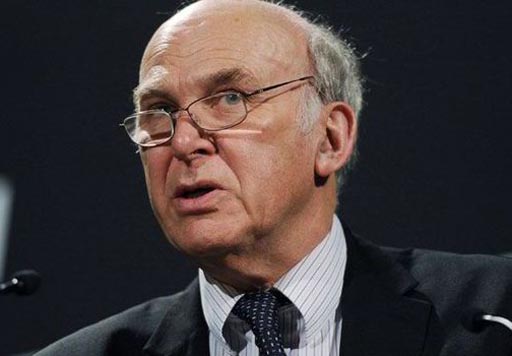
And today, we see a variation of the same thing with the intervention of Vince Cable, who tells usthat leaving the EU would be "self-indulgent and reckless".

No "serious friend of British business" would call for a break-up of Britain's relations with the EU, he is to tell a business conference in Birmingham, warning that if Britain quit the EU, he will warn, "we could reasonably expect an exodus of the non-EU firms headquartered in this country, precisely because they regard the UK as the gateway to Europe". 

However, no one in their right mind (other than the Judean People's Front) would actually call for "a break-up of Britain's relations with the EU". In or out of the EU, we still need a relationship with the member states of the EU. Thus, the question is how those relations would be managed.

Cable is, of course, spreading FUD, but it is that which sterilises the discussion, and makes it so unremittingly tedious. We never seem to be able to get down to the core issues, discussing the merits of membership and how we would fare outside the European Union under various exit scenarios. 

Instead of that debate, all we get is a load of Balls.

COMMENT: COMBINED REFERENDUM THREAD

EU referendum: a step closer

000bone amendment.jpg

I'm not quite sure when the practice stopped but certainly before the war, an important debate in Parliament would get at least two full pages of coverage. And that was in the days when the likes of the Daily Express was a broadsheet. The reports, in eight, densely-printed columns, with only tiny pictures, would run to several thousand words.

Now, we just get the highlights, which means the flavour of the debate comes via the filter of the reporters covering the story – and most often they are either working from agency reports, or broadcast highlights. 

There is, however, some compensation in that we can watch the debates live and read the Hansard reports later. I prefer to do the latter, finding the written word more reliable without the distraction of the theatricals. Thus, while the MPs were chuntering at each other this evening, I was actually watching a decade-old episode of West Wing on the internet. I'll read the full debate tomorrow. 

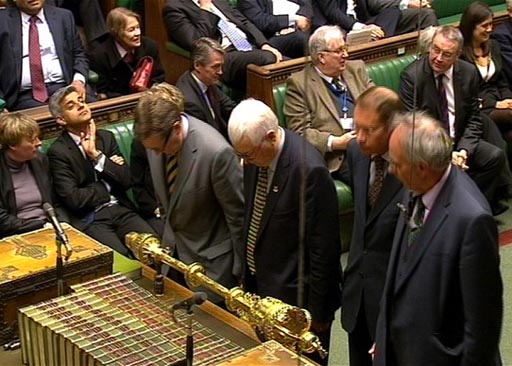
Anyway, the headline news is that 114 Conservative MPs voted for John Baron's amendment to the Queen's Speech "expressing regret" that an EU referendum Bill had not been included in the Government's legislative programme for the next session. 

This is slightly more MPs than had been anticipated but, nevertheless, the amendment was defeated by 277 votes to 130. Labour and Lib-Dem MPs responded to their whips, and toed the party line. Strictly though, the Tory vote was not a rebellion or a mutiny, as there had been a free vote. 

The good news is that at least this blog is back doing the very thing is was set up to do when we set it up on 22 April 2004. That makes us now just over nine years old. By the time we get a referendum in 2017, if we do, the blog will be thirteen years old, longer than a typical life sentence for murder. 

The bad news is that it could be another five years after than before we see a referendum – depending on a lot of things, including the outcome of the general election, so the blog could be 20 by the time we see the results come in. 

With that thought, we take comfort in the view of the Independent which thinks that David Cameron's "bloody nose" tonight brought an EU referendum a step closer. 

Please let it be so.

COMMENT: COMBINED REFERENDUM THREAD

EU referendum: a significant event

000Nick-Clegg-77012.jpg

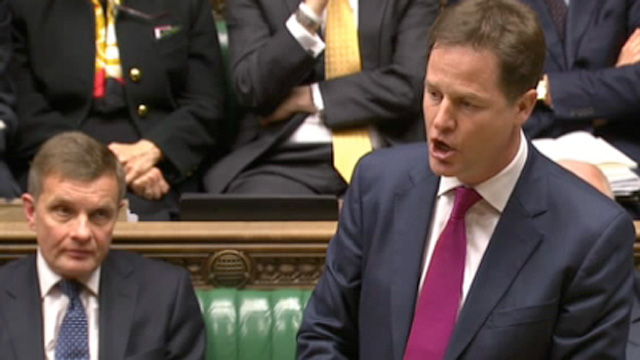
By the media and the paid politicians, almost any subject can be trivialised to the extent that it becomes a low-grade soap opera. And that transition was managed with consummate ease earlier this morning during PMQs, when deputy prime minister Nick Clegg stood in for Mr Cameron.

Perhaps the highlight of the event was Edward Leigh taunting the Clegg with a copy of a 2008 Lib Dem leaflet (below left) in which he declared: "It's time for a real referendum on Europe" at the time of the Lisbon Treaty negotiations.

Leigh, asked Mr Clegg whether the man pictured in the leaflet was "an impostor or just a hypocrite", only to get a dead-bat reply that he was in favour of a referendum when the rules changed.

000Libdem Referendum.jpgClegg, in turn, complained of the Conservatives of "constantly shifting the goalposts" on a referendum. He said the Commons had spent a hundred hours debating the Bill which gave a legal guarantee of a referendum if powers were transferred to Brussels. Nevertheless, he now seems to concede that a referendum is inevitable.

In anticipation of a vote today on an amendment to the Queen's Speech, the deputy prime minister declared: "We on this side should go out and promote what is in the Queen's Speech, not spending days bemoaning what is not in the Queen's Speech", then adding: "I think we should stick to the priorities of the British people, which is growth and jobs".

This is a theme echoed by Paul Goodman on Tory Diary, who is relying on a time-honoured formula in an attempt to defuse the "Europe" issue. "The matters that most move the British people at the ballot box", he claims, "are the meat, potatoes and two veg of British politics: the economy, hospitals, schools and crime - plus, of course, immigration".

Notwithstanding that these issues are all, to a greater or lesser extent affected by our membership of the EU, Goodman is unwittingly illustrating what we should have a referendum on the EU. Such constitutional matters tend to be swamped by more immediate concerns in a general election, so they should be deal with separately, with the referendum format being the most appropriate mechanism.

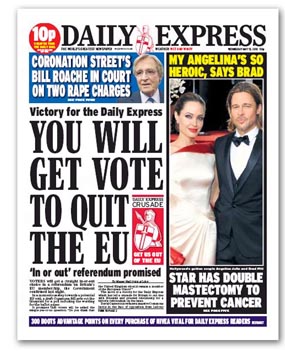
000Express 015-qui.jpgWhat is interesting though is the contrast between this mealy-mouthed response and the triumphalism of the Daily Express which was the only national newspaper to give the referendum full frontal treatment this morning (right). Claiming a victory for its own campaign, it announces without equivocation that we are to get a straight in-or-out choice in a referendum on Britain's EU membership.

In a dismissive response, however, Nigel Faragedeclares that, "This latest talk of an EU Referendum is nothing more than gesture politics". Thus, his earlier-declared stance of planning to stand for Westminster in 2015 is still in force, which means that the effect of UKIP's intervention could be to ensure that we have a Labour government and no referendum.

Meanwhile, we have the putative rebellion of up to 100 MPs, in the Queen's Speech vote, which is scheduled for 7.15 this evening. As Labour and the Lib-Dems were whipping their MPs against the motion, it is almost certain to fall.

Dominic Sandbrook in the Daily Mail is amongst the many who see in this evidence of the Conservative Party tearing itself apart, Sandbrook himself relying on comparisons between Mr Cameron and John Major.

This also allows the loss-making Guardian to question Mr Cameron's leadership skills, asserting that he once led his party by challenging it, but now meekly muddles through by pandering to its obsessions.

But, for all that, the publication of the draft Bill seems to have had an effect. We are told that the rebellion is "fading away", possibly signifying that MPs attach more significance to the referendum promise than does Mr Farage.

Certainly, an evidently frustrated Daniel Hannan has bought the package – but then you would expect that. However, one has a sneaking sympathy for his complaints about the tendency of lobby journalists to look at the EU through the tinted glass of party management. He thus observes that, amid the hubbub about "Tory splits", we are in danger of missing the magnitude of what is taking place.

We are no fans of young Hannan here, but in this one instance, I tend to veer closer to his "take" than anything the likes of Iain Martin has to offer. This man, whose own judgement is very often suspect, thinks the Conservatives have "lost the plot".

To me, that is the kettle calling the pot black. I think we are looking at an event of some magnitude here, one which the media and the serried ranks of MPs have not entirely succeeded in trivialising. And such are the dynamics of the Cameron offer that I would not be entirely surprised to see Labour and the Lib-Dems supporting the idea of a referendum.

Indeed, Cameron is now on the attack, saying that the "focus" must now shift to Labour and the Lib-Dems and whether or not they would be prepared to offer the British public a vote on Europe. He is criticising the two party leaders for "pretending nothing has changed" in the EU in recent years, putting them on the back foot.

But, once the events of this day are over, the real focus must then shift to king-maker Farage and his UKIP supporters. As the reality of a referendum seems to be firming up, Farage may come under pressure to rethink his somewhat glib response.

If it has become the role of UKIP to deny us a referendum on the EU, then he had better start telling us what he has in mind as an alternative.

COMMENT: COMBINED REFERENDUM THREAD


Richard North 15/05/2013
Edit

 EU budget: a done deal 

 Wednesday 15 May 2013
000Osborne 015-bud.jpg

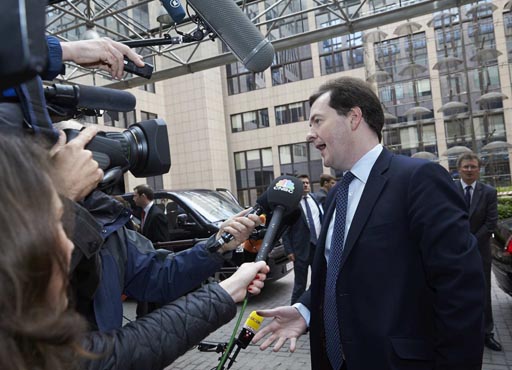
We warned last week that it was on its way. And now it is here (see page 9). The finance ministers of the EU member states, including Mr George Osborne, have agreed to provide an additional €7.3 billion for the 2013 budget, as the first tranche of an overall figure that will eventually reach €11.2 billion.

The "amending budget no.2" will add about £800 million to Britain's EU bill, with potentially another £400 million to find when the complete deal is reached. That will come with the second tranche, expected to be agreed after the summer break, bringing the additional British liability to £1.2 billion.

The sum so far agreed represents rise of 5.5 percent on the original budget of €133 billion agreed for this year, itself and increase on the previous year's budget (2012) of €129.1. With the budget now standing at €140.3 billion, that represents an 8.7 percent year-on-year increase, kicking into touch any idea of EU budgetary restraint.

Needless to say, Mr Osborne has been very quiet about this, and the UK media has been playing it relatively low key, making light of the British humiliation. Only the BBC hints at the scale of the defeat, citing a British government source who said the government could not support the amending budget. But, with the vote taken by QMV, there was nothing a powerless Mr Osborne could do.

Ironically, this came on exactly the same day that the Conservative Party published its draft Bill for an EU referendum. The Party could well have pointed out that we were having to find another £1.2 billion to feed the ravening maw of Brussels, making it another good reason why we should be planning our exit.

And still there is the battle of the multi-annual budget to come. Then there will be many more amending budgets to come, as the "colleagues" attempt to chip away at the hidden deficit which technically makes the EU insolvent.

Unsurprisingly, we saw yesterday Kenneth Clarke claim that us leaving the EU could "spell catastrophe for the economy". What Clarke didn't specify, of course, was that the real catastrophe would be to the EU Commission's economy. They desperately need our money – and much more of it. We have not heard the last of this.

COMMENT THREAD

The European transactions tax -- an act of pure hope?

My latest column in Bloomberg came out about a week ago. Forgot to mention it. The story is this: The European Commission has very firm plans to introduce a financial transactions tax -- a "Tobin" style tax -- on most financial transactions at the beginning of January 2014. That's just over 6 months away. I was surprised to learn they were taking this step, as I thought that very little was really known about the likely consequence of such a tax, especially introduced on such a grand scale. So, I spent a week or so looking into all the research I could find on financial transactions taxes, theoretical and empirical, and came to the conclusion that -- indeed, very little is known. But Europe is going ahead anyway!

If anyone wants to look at some of the original research, I suggest having a look at the following few things. First, the best overall review is this one by Neil McCulloch and Grazia Pacillo of the University of Sussex. Their conclusion is, in two sentences, that...
We conclude that, contrary to what is often assumed, a Tobin Tax is feasible and, if appropriately designed, could make a significant contribution to revenue without causing major distortions. However, it would be unlikely to reduce market volatility and could even increase it.
But if you read the report, you'll see that the outcome seems very likely to depend on fine details of how the tax is implemented and of the markets to which it is applied.

Other important studies are this one by Westerhoff and Pellizzari which uses an agent based market model to test how the consequences of a transactions tax might depend on market microstructure. I think this is among the most sophisticated studies done to date (although it can still be improved in many ways and represents a beginning, not an end). There's also an older review from 1993 by Schwert and Seguin that I read and which is useful (sadly, I'm not sure where the link is.... I have a pdf and found it by googling, that's all I can say). Finally, if you have the brave heart to read the original impact assessment of the EC proposal for the tax, it is here. That report doesn't actually mention any research on how the tax will likely influence markets, but only looks at how the macroeconomy might be effected.


The real worry over Europe...

What's the most important thing to worry about in Europe - or with the economic crisis more generally? I think for many people -- especially economists of the Chicago school -- the biggest concern is that we might lose a couple of percentage points of cherished growth over the next ten years, leading to a tragic loss of GDP relative to where we might have been. But the really important thing about this crisis isn't about money or wealth, but about social stability. George Soros, as usual, sees more clearly than others:
I have been very concerned about Europe. The euro is in the process of destroying the European Union. To some extent, this has already happened, in the sense that the EU was meant to be a voluntary association of equal states. The crisis has turned it into something that is radically different: a relationship between creditors and debtors. And, in a financial crisis, the creditors are in charge. It is no longer a relationship between equals. The fate of Italy, for example, is no longer determined by Italian politics – which is in a crisis of its own, I would say – but rather by the creditor/debtor relationship. That is really what dictates policies.
The point is that this European crisis is NOT JUST a financial crisis. It is much more serious than that. It's a political and social crisis. We talk about it in financial terms, but the really important thing is a massive breakdown in cooperation and political function, obviously in Europe, but elsewhere as well. A few years ago, the idea of a global financial crisis seemed pretty hard to imagine. What are we failing to imagine now?

Soros also has a few thoughts on austerity:
The evidence is growing that austerity is not working. Sooner or later, I expect a reversal of the current fiscal policy – the sooner, the better. There is a political problem, namely that the creditors dictate economic policy. And there is a financial or an economic problem, namely that the policy the creditors advocate is counter-productive. The rest of the world, in the face of excessive unemployment, is no longer trying to reduce prematurely government debt accumulated during the financial crisis. And the rest of the world engages in quantitative easing. The latest convert is Japan, where the central bank has been forced to abandon its orthodox monetary policy. So I think it is only a matter of time. Something has to give in Europe, because Europe is out of touch, out of synch, with the rest of the world.

EU budget: a done deal

000Osborne 015-bud.jpg

We warned last week that it was on its way. And now it is here (see page 9). The finance ministers of the EU member states, including Mr George Osborne, have agreed to provide an additional €7.3 billion for the 2013 budget, as the first tranche of an overall figure that will eventually reach €11.2 billion.

The "amending budget no.2" will add about £800 million to Britain's EU bill, with potentially another £400 million to find when the complete deal is reached. That will come with the second tranche, expected to be agreed after the summer break, bringing the additional British liability to £1.2 billion. 

The sum so far agreed represents rise of 5.5 percent on the original budget of €133 billion agreed for this year, itself and increase on the previous year's budget (2012) of €129.1. With the budget now standing at €140.3 billion, that represents an 8.7 percent year-on-year increase, kicking into touch any idea of EU budgetary restraint. 

Needless to say, Mr Osborne has been very quiet about this, and the UK media has been playing it relatively low key, making light of the British humiliation. Only the BBC hints at the scale of the defeat, citing a British government source who said the government could not support the amending budget. But, with the vote taken by QMV, there was nothing a powerless Mr Osborne could do. 

Ironically, this came on exactly the same day that the Conservative Party published its draft Bill for an EU referendum. The Party could well have pointed out that we were having to find another £1.2 billion to feed the ravening maw of Brussels, making it another good reason why we should be planning our exit. 

And still there is the battle of the multi-annual budget to come. Then there will be many more amending budgets to come, as the "colleagues" attempt to chip away at the hidden deficit which technically makes the EU insolvent. 

Unsurprisingly, we saw yesterday Kenneth Clarke claim that us leaving the EU could "spell catastrophe for the economy". What Clarke didn't specify, of course, was that the real catastrophe would be to the EU Commission's economy. They desperately need our money – and much more of it. We have not heard the last of this. 

COMMENT THREAD