Media: the other side of the coin

000Johnson 019-cou.jpg

While there may be reasons why the media isn't telling us things, it is as well to ponder about the other side of the coin - why it is telling us the things it does. And leaping into that category is the news about "Bopris" (as the Mail happily misspells him in one of its captions) fathering a previously secret "love child" (aka bastard).

What is interesting about this piece of news is the extent to which Mr Johnson sought to conceal it, and the effort which the Mail sought to publish it, defending a case in the High Court and then fighting a case in the Appeal Court.

In this latter case, the findings of Master of the Rolls Lord Justice Dyson are pretty damning, the judge effectively ruling that the public has a right to know about Boris Johnson's philandering past, which takes precedence in this instance when "weighed in the balance against the child's expectation of privacy".

The disclosure, however, is more that just a news story. From last year when Mr Johnson was the darling of the media and being widely slated as the next Conservative prime minister, possibly deposing the incumbent, this amounts to a signal that his bid for the leadership is over.

Even the Telegraph Media Group Ltd, which must have been aware of its employee's behaviour, but so far kept silent, has been forced to out its employee.

And, with the outing, it may well be that Mr Johnson's utility as an over-paid columnist is numbered. Certainly, to some of the business's customers, his attraction will be reduced and – as anIndependent poll indicates – to a measurable extent.

But what is also very interesting is Mr Johnson suddenly became so popular – especially as this is a man with few demonstrable leadership skills who handled the August riots badly, and who has none of the political experience that would be required of a prime ministerial candidate. Not only is he not, currently, an MP. He has no ministerial much less cabinet experience.

One suspects here that Johnson found so much favour with the media for the same reason that Mr Farage is so much in vogue – he was a useful stick with which to beat David Cameron. And, if that is the case, now that Mr Farage has so willingly stepped up to the plate, the London Mayor is redundant.

There, possibly, is the real agenda behind today's news. For you, Meester Johnson, ze varr ees over. And you read it first in the Daily Mail.

COMMENT THREAD
Media: you read what you are allowed to read

000Censorship.JPG

One of our number remarked recently on the absence of any mention of Article 50 from the broad sweep of the legacy media. A quick search proved that to be the case.

Autonomous Mind coincidentally notes the role of Article 50 as an antidote to FUD, the latter from the Goldman Sachs stable. Its report author was careful to avoid any reference to the potential of the Article to enable an equitable settlement to be negotiated, in circumstances which must be deliberate. 

One wonders, though, whether the general absence of comment in the media represents active censorship, which is turn invites dark thoughts of conspiracy between media bosses. 

Before these thoughts are dismissed outright, the emergence of yesterday's piece from Booker provides more than adequate testimony that pieces which contradict the editorial line do get spiked. Active censorship is a fact of life in the media, and everything you read is filtered through the system of editorial approval. 

So it was in the early days of UKIP in the European Parliament, where we found that stories submitted by journalists which mentioned UKIP were edited, and any reference to the party was removed. 

As a result, self-censorship took over. Not uncommonly, journalists would remove quotes attributed to Farage or one other of our MEPs, and similar quotes substituted, bearing the names of Tory MEPs. Daniel Hannan, himself a Tory MEP and then a leader writer for the Telegraph Media Group Ltd, was particularly prone to this, something for which I have never really forgiven him. 

This does remind us though that the current wave of publicity afforded to Farage and his party is neither accidental nor spontaneous. He gets publicity at the pleasure of the media barons - because they permit it. The moment that permission is withdrawn, Farage will disappear into the obscurity from which he emerged. 

That further raises the question as to why Farage is getting such a volume of (largely) favourable publicity, especially as the corporate businesses that run the major newspapers do not share his values or objectives. With the possible exception of the Express none want to withdraw from the EU. Given the opportunity, all will support any renegotiation concluded by Mr Cameron or his successor, no matter how weak it might be. 

An obvious conclusion to draw from this is that Farage, and thereby his members, are being used. Senior Tory members are convinced that he is a convenient stick with which to beat Mr Cameron, who has – for several and different reasons – fallen out of favour with the media barons and their corporate interests. 

Should Cameron at some time rebuild his bridges, or a more acceptable replacement be put in place, Farage will be ditched, leaving UKIP members in the wilderness. At the moment, journalists are being allowed to play, but the moment business gets serious – round about general election time – the teachers will rap the table, and the children will be brought back into line. 

That gives the clue to the treatment of Article 50. On the face of it, invoking the Article, seeking EFTA/EEA membership, and repatriating the acquis offers a sensible, temperate solution to withdrawing from the EU. It minimises any collateral damage and allows trade to continue uninterrupted, without loss. 

And that, of course, is the last thing that the corporates - which include the media interests -actually want. They do not want a solution to the problem, otherwise people might agitate for it, and we could end up actually confronting a successful withdrawal. Thus, they will publicise Farage, under license, but not Article 50. 

Through this dynamic we get the surreal situation where the self-appointed "expert" from Open Europe manages to write a long piece about leaving the EU, without mentioning Article 50 once. It is raised only in the comments by a reader.

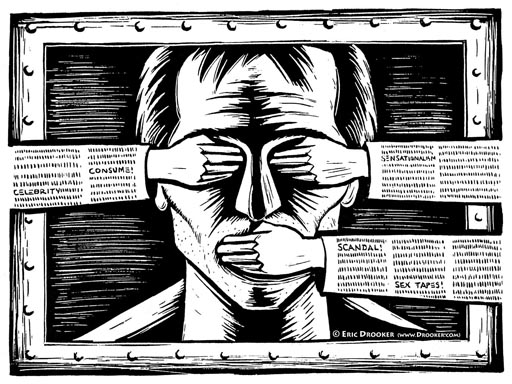
The point to emerge from all this is the reminder that we are very far from enjoying a free press in this country. Anything of political significance that you are able to read in the print media is there only because someone decided you should be allowed to read it. 

There may be exceptions, but these only go to prove the rule. A few licensed dissidents – such as Booker - are allowed. They are treated with benign amusement, and kept on because they have high page traffic. But they are kept firmly in the "ghetto" and not allowed to play with the rest of the girls and boys. 

Sadly, though, people – the dwindling band that continue to read newspapers and believe what they say – actually believe that they are well-informed after they have expended so much of their life-energy reading the tat they are permitted to see. 

But they should never forget that most censorship comes not from governments but from the media itself. They have the power to dictate the agendas and they are not at all reticent in using that power. You read only what you are allowed to read. 

COMMENT THREAD

EU referendum: a common vision

000goldman 020-out.jpg

The first thing you need to know about Goldman Sachs, it says here, is that it's everywhere. The world's most powerful investment bank is a great vampire squid wrapped around the face of humanity, relentlessly jamming its blood funnel into anything that smells like money.

That was written a while ago, but it may give some hint to the fact that this blood-sucking parasite it not universally adored. And it may, therefore, be a mixed blessing for the europhiles to have it reporting that a British departure from the EU would result in a "loss/loss scenario" in which both the UK and the rest of the bloc would be damaged. 

The report is from Kevin Daly, a member of the investment bank's economic team, and it says that a UK exit would "come with a significant economic cost to the UK" because it is "highly integrated" with the EU. 

Crucially, Daly then dismisses those who argue that Britain could negotiate a trade deal with the EU once it had left. "Given the size and importance of the UK economy, it is unlikely that the UK could negotiate the same access to the EU single market that Switzerland and Norway have achieved", he says. 

Now, that Mr Daly so carefully refers to Britain negotiating a trade deal with the EU "once it had left" cannot be an accident. It must be done for effect, especially as Article 50 refers to negotiationsbefore a withdrawing country leaves. 

Assuming that the default position of any responsible government would be to invoke Article 50, Goldman Sachs is therefore engineering a scenario which is both extreme and highly pessimistic - and not provided for in the Treaty. And, without it offering a range of scenarios, this can only mean that the bank is talking a partisan and therefore worthless line. 

The thing is, of course, is that the UK could opt for membership of the EEA via EFTA, and for repatriating the entire aquis. This may not be acceptable to the "unilat" fundamentalists of UKIP, who are singing from the same songsheet as Goldman Sachs, but it is a tenable option and one espoused by at least one British cabinet minister. 

But then, Goldman Sachs could not possibly consider this scenario if it is to stand up its headline finding that the UK leaving the EU would be a "loss/loss scenario". And, for a company that works hand in glove with the European Commission, this is the only conclusion that its employees would be permitted to draw. 

It was, after all, Goldman Sachs alumni, Mario Monti who took over the governance of Italy at the behest of the Commission, it was Goldman Sachs who cooked the accounts to allow Greece to join the euro, and it was then Goldman Sachs people who engineered the Greek "bailout" and the haircuts which tipped the country into the depression. 

That such an eminently untrustworthy organisation thus reports adversely on the UK exiting from the EU is, therefore, no bad thing. But how fascinating it is that both Goldman Sachs and the UKIP fundamentalists share a common vision of how the UK will manage its departure. 

COMMENT THREAD

Media: Booker uncensored

000Cameron 019-hus.jpg

As the pages of the Telegraph and the Mail are swamped with pieces about the ongoing crisis at the heart of the Tory Party, the ever widening rift between David Cameron and his grass roots, it may be germane to recall a curious episode back in December 2006, a year after Cameron became the Tory leader. 

On the Friday of that week, as usual, Christopher Booker submitted his column for the Sunday Telegraph, including a lengthy item analysing why it was already clear that what he called "the greatest gamble in modern British politics" had not come off. 

This was Mr Cameron's attempt to turn the Tories into a "Not The Conservative Party", contradicting pretty well every principle the Tory grass roots believed in. 

On the Saturday afternoon, just when the paper was due to go to press, he received an incandescent call from his then-editor, Patience Wheatcroft. There was no way she could allow such a piece to appear in her paper. That week's Booker column would have to appear in absurdly truncated form. 

This little incident briefly caused a flutter of interest behind the journalistic scenes, prompting some mischievous observer to post entries for Wheatcroft and Booker on Wikipedia, describing what had happened, But these before long disappeared, Ms Wheatcroft herself did not last much longer as editor, her successors never censored Booker in such a way again, and history rolled on. 

Six and a half years later, however, as the rift between Cameron and the Tory grass roots, contemptuously dismissed by his party chairman as "mad, swivel-eyed loons", makes front-page headlines - with Nigel Farage taking out a full-page advertisement in the Daily Telegraph inviting disaffected Tories to come over to UKIP en masse - those words which Telegraph readers were never allowed to see now seem even more apt than they might have done at the time, 

This was what Booker wrote:
David Cameron ends his first year as leader of the Opposition, there are clear signs that the greatest gamble in modern British politics has not come off. The little group of ex-public schoolboys who last year hi-jacked the Conservative Party have seemed to gamble on just one strategy. List everything the Party used to stand for – low taxes, the family, rolling back the power of the state, encouraging business, upholding our defences, curbing criminals, common sense – then go for the opposite.

The essence of the gamble has been the belief that, in wooing the support of Lib Dems, would-be greenies, Guardian readers and the supposed "soft centre", they could take their supposed "core" supporters for granted. But as support for Cameron falters, all the evidence seems to suggest that those wished-for new recruits to his "Not The Conservative Party" are not forthcoming, while the Party's former natural supporters are left baffled, dismayed and increasingly angry.

All this was neatly symbolised by the recent photo-opportunities staged by the three men now competing for the role of Britain's prime minister. Mr Blair and Mr Brown, aware that defence and national security (not long ago rating 34 percent on a Mori poll) still rank very much higher as voter priorities than "environmental" issues (only eight percent), flew out to the Iraq and Afghan battle-zones to pose in front of the largest guns they could find. Mr Cameron, at the same time, flew out to the Sudan, in Lord Ashcroft's CO2 emitting private jet, to be pictured cuddling a little refugee child. It was the "Men from Mars" against "the Boy from Venus". "Darfur Dave" did not come well out of the contrast.

The tragedy is that, confronted by the most corrupt, hypocritical, inefficient, illiberal, discredited government in history, what millions of voters are looking for is an alternative which might put an end to the sleazy, self-regarding sham of the Blair era by displaying some "masculine" firmness: in cutting back on the bloated public sector and the out-of-control bureaucracy which is destroying our health service, education and police; which might encourage enterprise; which might restore democracy to local government; bring back some balance into our public finances; sort out the shambles into which our Armed Forces are sliding; uphold Britain's national interest, as we suffocate under the malfunctioning system of government represented by the European Union.

In other words, what much of the country is crying out for is a party which represents precisely those values which Mr Cameron's Not-The-Conservative Party seems so hellbent on abandoning. As for what he stands for instead, almost the only clear message Darfur Dave seems to have put over to the voters is his sentimental "save the planet" greenery, on which his dotty little gimmicks and practical ignorance have simply made him a laughing stock.

What many voters sadly begin to conclude is that Dave and his cronies seem so hopelessly ill-equipped to take on the serious business of government that, if we have to choose between one gang of PR merchants and another, better stick with the devil we know. Hence the evidence of the latest polls appearing to show that the gamble has failed. Ever larger become the number of would-be Conservatives sorely tempted to join that 40 percent who already feel so alienated from politics that they just stay sullenly at home. But the Guardian readers are scarcely flocking to replace them. So where does all this leave our country?
And that was more than six years ago. Even more so now than then, we are asking the same question. As the Conservatives go into complete meltdown, where does all this leave our country? 

COMMENT THREAD

EU referendum: none of your business

Inde 019-dis.jpg

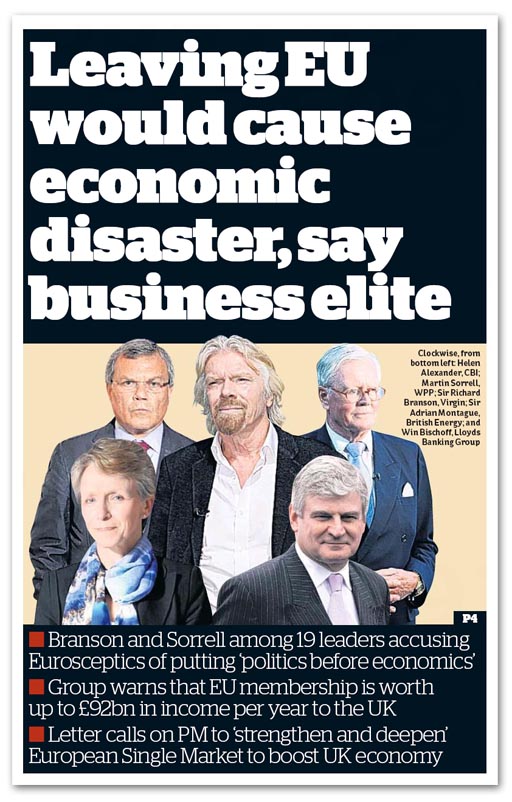
The europhile Independent wants us to believe that economics is more important than politics, giving a group of self-interested corporates license to peddle this lie in a letter to the paper, with front-page treatment afforded in this and the sister "I" publication.

It is in the latter paper that the lie is at its most prominent, the front-page legend (illustrated above) having it that, "Leaving the EU would cause economic disaster". And an egregious lie it is. Given our exit scenario, where we maintain the Single Market through membership of the EFTA/EEA, and then repatriate the acquis, the net effect of our withdrawal from the EU is economically neutral. 

For sure, we lose some of our influence in the decision-making on the EU's versions of the rules for the Single Market, but this is largely compensated for by our regaining our influence on international bodies such as the WTO, UNECE, etc., from where most of the rules originate in the first place. 

What these corporate pirates are doing, though, is conflating membership of the Single Market with membership of the EU. The very last thing this dishonest crew wants to do is admit that we can be members of the Single Market without belonging to the EU. 

In peddling their lie, however, the corporates are aided and abetted by the "unilats" – the eurosceptic groupuscules who are wedded to the idea of unilateral withdrawal. These people are intent on precipitating exactly the economic disaster of which the corporates are now warning. 

Nevertheless, the corporates have over-reached themselves. In complaining about eurosceptic MPs putting "politics before economics", they are placing their interests above those of the people. The EU is a political construct, and the argument over withdrawal is political. It is not about economics. It is about who governs Britain. 

In this, elected MPs are perfectly right to put politics before economics. It is totally out of order for former VAT fraudsters like Branson to suggest otherwise. Business has every right to expect that its interests are taken account of, but when it comes to how we are governed, that is none of their business. 

We the people must make that decision, and without the interference of the self-interested corporates, represented by the chairmen of BT, Deloitte, Lloyds, Centrica and others, who, when push comes to shove, are only interested in lining their own pockets at our expense. 

COMMENT THREAD

EU referendum: hostages to fortune

000Mandelson 018-mar.jpg

Former EU trade commissioner Peter Mandelson was in full flow on the Andrew Marr Show yesterday. But what he said was of very little importance in the greater scheme of events, any more than anyone really gives a damn about what "dead sheep" Lord Howe has said.

What might stick, though, is Mandelson's jibe about UKIP whom he called the "UK Isolation Party". That is just the sort of snide slur that can gain a certain currency, and it struck me at the time that it was far from spontaneous. This has been worked on by Mandelson and his little friends, all part of the classic technique of denigrating the opposition. 

If it does stick, though, it will be because there is a grain of truth in it. One just has to look at the comment threads on the online Booker columns, and other threads on EU-related issues. Very visible and voluble are the self-identified UKIP members who demonstrate by their comments that their only interest is immediate withdrawal from the EU, whatever the cost, and whatever the damage caused. 

This we also see on our own forum, the relentless advocates of unilateral withdrawal who are so obsessed with leaving that they would destroy any chance of a negotiated settlement and cause endless damage to British business and other national interests. 

What these people don't seem to realise, though, is that our withdrawal will almost certainly depend on us winning a referendum. And it is there, where the vote is soft that we will be relying not on the politically committed, but on the swing voter, who will have no settled view on the EU issue. 

What people also need to realise is that political engagement is a minority occupation. Only a tiny and diminishing band of people follow politics. The "mainstream" media is in fact purveying a minority view, and the bulk of people who get their news only from television rarely give the bulletins their full attention. 

Yet, it is these people upon whom will be relying to get us out of the EU. They are people we haven't spoken to yet. These are people who don't read the comments (thank goodness) and who don't read the blogs. Many of them don't even vote in most elections. 

But it is these people who will be most affected by the scare tactics of the europhiles, and the claims of people like Mandleson, who revel in claims that we are isolationists and "little Englanders". And they will be given plenty of opportunities by the BBC and the legacy media to make their points. 

Then, it will we our own rabid, swivel-eyed loonies, foaming at the mouth about "traitors" and "illegal treaties", German domination and all the rest, who let us down. 

Their squealing for immediate repeal of the European Communities Act, regardless of the damage caused, will seem to confirm the slurs from the Mandelsons of this world, giving their claims credibility as they seek to tar us all with the same brush. 

Thus, as eurosceptics, we need to be thinking hard, not only about our arguments, but how they play with the politically uncommitted. What might sound good to the faithful, or stack up the "recommends" on the comment threads, are not necessarily the arguments that are going to convince the swing voters. 

To do that, we are going to have to be careful what we say, and compromise. What many committed eurosceptics could end up doing, in promoting their preferred courses of action, is alienating – or frightening - ordinary people to such an extent that we end up losing a referendum. 

As it stands, it is going to be difficult enough to win. There is no need to make it impossible. 

COMMENT THREAD

EU referendum: disturbing stability in the polls

000Telegraph 018-pol.jpg

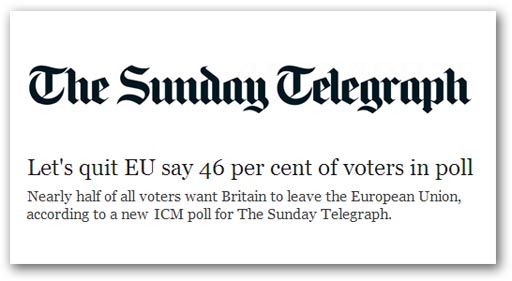
The Telegraph Media Group Ltd is citing an ICM poll today which has 46 percent of respondents saying they want to leave the EU, as opposed to the 30 percent who want to remain – giving a 16 point margin in favour of withdrawal.

In the Independent on Sunday we have the results of a ComRes poll and it also puts the number wanting to leave at 46 percent, as opposed to 25 percent who want to stay in. That gives us a slightly healthier margin of 21 percent. 

However, this poll also tells us that voters would back remaining in the EU by a margin of 43 to 24 percent if some (unspecified) powers were returned to the UK, a finding which is very similar to the June 2012 YouGuv survey which found that people would elect to stay in the EU by a margin of 42 to 34 percent. 

Taking that last finding, on the face of it, the margin for staying in the EU following renegotiation has strengthened from eight percent just over a year ago, to 19 percent currently, in what could be considered a boost for Mr Cameron. 

But the main findings are nothing to write home about either. The 16-point ICM margin compares unfavourably with the Mail on Sunday poll last October, which gave a 17-point lead to the "outers". But, when the YouGov poll in July 2012 also gave the "outers" a lead of exactly the same 17 points, one can conclude that sentiment is not moving a great deal. 

One can take greater comfort from the ComRes poll and its 21 percent margin, but that would only represent a four-point shift in a year which has seen an upsurge in support for UKIP and a supposed strengthening of anti-EU sentiment. 

Here, we have to remind ourselves – as always – of the private poll conducted for the Labour Party in August 1974, which showed that, should there be a referendum on membership of the Common Market, 50 percent would vote to leave, against 32 percent who would vote to stay in, a "huge" lead of 18 points. 

At around the same time, Gallup confirmed these proportions, with a poll coming out at 47-30 percent in favour of leaving, giving a lead of 17 percent, almost exactly the same as the ICM poll. And, as we well know, nearly a year later in 1975, 67.2 percent voted to stay in the EEC, while those voting to leave had fallen to 32.8 percent – a lead of over 34 percent in favour of staying in, representing a swing of over fifty percent. 

What is puzzling about the current findings is the stability of anti-EU sentiment. In broad terms, it has hardly moved in years and seems largely resistant to the ebb and flow of the debate on the EU. And, if we are to take the historical precedent, the level of support for withdrawal is by no means enough to ensure a victory in any coming referendum. 

Patrick Hennessy in the Telegraph ventures the opinion that 44 percent wanting an immediate referendum – as opposed to 29 percent prepared to wait until 2017 – represents a "further boost for the eurosceptic cause", but on current showing, we would most certainly lose an early referendum. 

The most disturbing thing, though – given the lack of movement in the polls and the favourable response to the suggestion of renegotiation – is that we might lose a referendum in 2017 as well. 

We can only hope that the opinion dynamics might change when a referendum is declared. But, if they don't, it could be too late to find out why and affect significantly the course of public opinion. Anyone truly interested in getting out of the EU, therefore, might feel some alarm at these figures, and be looking for stratagems which might improve future odds. 

COMMENT THREAD