Booker: we can't have our cake and eat it in the EU

000Booker 018-cak.jpg

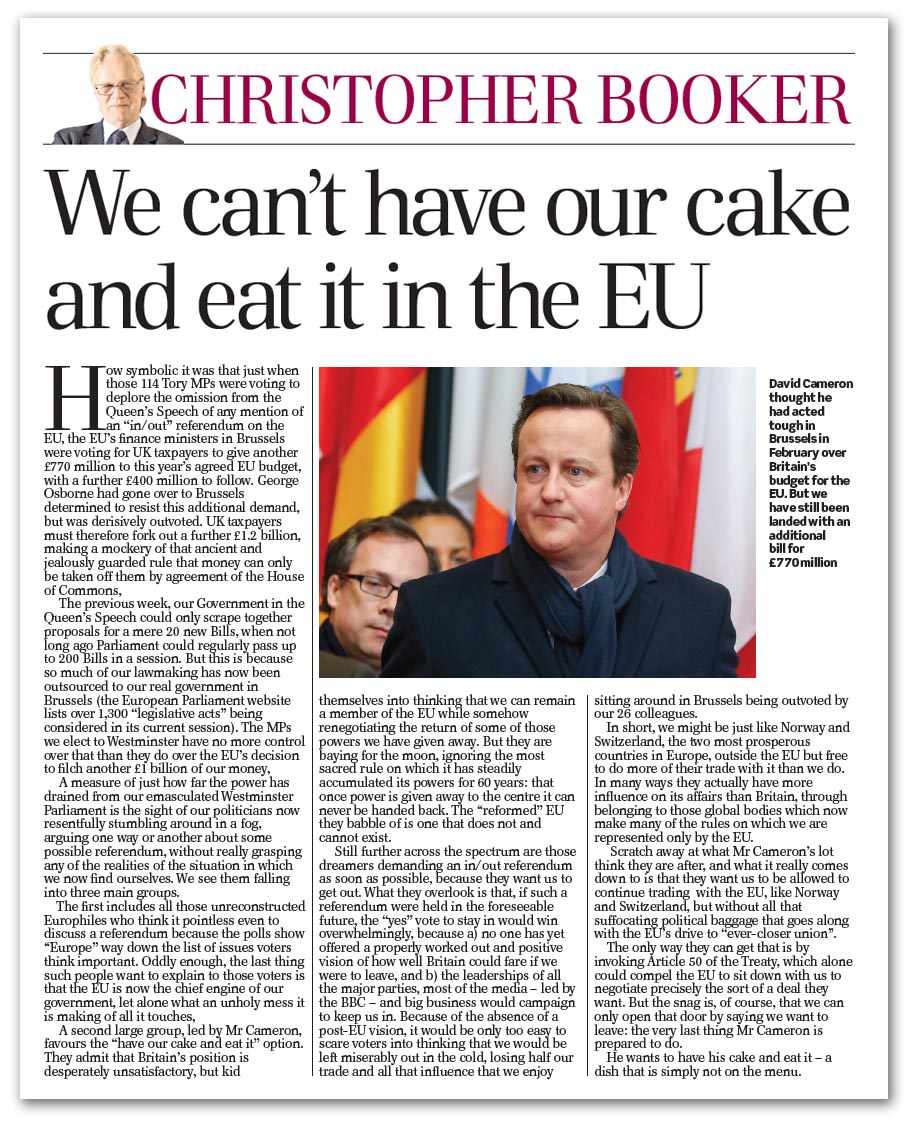
How symbolic it was, writes Booker, that just when those 114 Tory MPs were voting to deplore the omission from the Queen’s Speech of any mention of an in/out referendum on the EU, the EU's finance ministers in Brussels were voting for UK taxpayers to give another £770 million to this year's agreed EU budget, with a further £400 million to follow.

George Osborne had gone over to Brussels determined to resist this additional demand, but was derisively outvoted. UK taxpayers must therefore fork out a further £1.2 billion, making a mockery of that ancient and jealously guarded rule that money can only be taken off them by agreement of the House of Commons. 

The previous week, our Government, in the Queen's Speech, could only scrape together proposals for a mere twenty new Bills, when not long ago Parliament could regularly pass up to 200 Bills in a session. 

But this is because so much of our lawmaking has now been outsourced to our real government in Brussels (the European Parliament website lists over 1,300 "legislative acts" being considered in its current session). The MPs we elect to Westminster have no more control over that than they do over the EU's decision to filch another £1 billion of our money. 

A measure of just how far the power has drained from our emasculated Westminster Parliament is the sight of our politicians now resentfully stumbling around in a fog, arguing one way or another about some possible referendum, without really grasping any of the realities of the situation in which we now find ourselves. We see them falling into three main groups. 

The first includes all those unreconstructed Europhiles who think it pointless even to discuss a referendum because the polls show "Europe" way down the list of issues voters think important. Oddly enough, the last thing such people want to explain to those voters is that the EU is now the chief engine of our government, let alone what an unholy mess it is making of all it touches. 

A second large group, led by Mr Cameron, favours the "have our cake and eat it" option. They admit that Britain's position is desperately unsatisfactory, but kid themselves into thinking that we can remain a member of the EU while somehow renegotiating the return of some of those powers we have given away. 

But they are baying for the moon, ignoring the most sacred rule on which it has steadily accumulated its powers for 60 years: that once power is given away to the centre, it can never be handed back. The "reformed" EU they babble of is one that does not and cannot exist. 

Still further across the spectrum are those dreamers demanding an in/out referendum as soon as possible, because they want us to get out. What they overlook is that, if such a referendum were held in the foreseeable future, the "yes" vote to stay in would win overwhelmingly, because a) no one has yet offered a properly worked out and positive vision of how well Britain could fare if we were to leave, and b) the leaderships of all the major parties, most of the media – led by the BBC – and big business would campaign to keep us in. 

Because of the absence of a positive alternative, it would be only too easy to scare voters into thinking that we would be left miserably out in the cold, losing half our trade and all that influence that we enjoy sitting around in Brussels being outvoted by our 26 colleagues. 

In short, we might be just like Norway and Switzerland, the two most prosperous countries in Europe, outside the EU but free to do more of their trade with it than we do. In many ways they actually have more influence on its affairs than Britain, through belonging to those global bodies that now make many of the rules on which we are represented only by the EU. 

Scratch away at what Mr Cameron's lot think they are after, and what it really comes down to is that they want us to be allowed to continue trading with the EU, like Norway and Switzerland, but without all that suffocating political baggage that goes along with the EU's drive to "ever-closer union". 

The only way they can get that is by invoking Article 50 of the Treaty of Lisbon, which alone could compel the EU to sit down with us to negotiate precisely the sort of a deal they want. But the snag is, of course, that we can only open that door by saying we want to leave: the very last thing Mr Cameron is prepared to do.

He wants to have his cake and eat it, Booker concludes – a dish that is simply not on the menu.

COMMENT THREAD
EU regulation: olive oil in the frame

000COM 018-oli.jpg

There is an amount of wibbling over the announcement of an EU requirement to serve olive oil in restaurants in labelled, non-resealable bottles. In particular, we get complaints that the measure is "authoritarian and damaging to artisanal food makers", and condemnation of unaccountable technocrats (see comments). 

What is interesting, though, is that this proposal has been on the table for some years, as a way of increasing the support for the quality end of the industry, and reducing fraud. Marked, single-use bottles, it is felt, will reduce the amount of product adulteration, and thereby up the purchases of higher-grade product. 

The Italians were calling for non-refillable bottles in 2009 and two months ago passed the so-called "Mongiello Law" – on which the EU law is modelled – which requires single-use bottles or packs. Meanwhile, the Portuguese industry has been using non refillable bottles in restaurants since 2005, with positive results. 

Nevertheless, it is easy for the media to get renta-quotes from up-market Belgravia restaurants, and the statutory eurosceptic, about "EU bureaucrats", but they are missing the mark. 

The measure was only proposed by the commission after prolonged lobbying by producer organisations and after evidence of its effect in at least two countries. As to the law itself, it was passed not by EU bureaucrats but by member state officials, acting on instructions from their own governments, working through the mechanism of the food industry Management Committee.

In the committee, the measure was backed by fifteen member states, mainly the Mediterranean olive producers, including Cyprus, Greece, Italy, Spain and France, but also with the support of Ireland and Poland. Britain abstained and opposed were mainly northern states, amongst which were Austria, Denmark, Finland, Germany, the Netherlands and Sweden. 

Yet, for all the hyperventilation of the Telegraph Media Group Ltd, it concedes that the Spanish Association of Bars, Cafes and Restaurants has supported this new law. "Now we will be able to guarantee the quality of extra virgin olive oil on the table," said a spokesman – exactly the point made by an embarrassed commission spokesman on Friday, himself insufficiently briefed to tell the full story. 

And despite his inadequacy as a spokesman, given the widespread problem of olive oil adulteration which even the loss-making Guardian has noticed, he did have a point. 

COMMENT THREAD

UK politics: party activists are "loons"

000Telegraph 017-loo.jpg

Grassroots Conservative activists are "mad swivel-eyed loons" who are forcing Tory MPs to take extremist positions opposing gay marriage and Europe, one of David Cameron's closest allies has said.

That was according to the Telegraph Media Group Ltd,which is now asking who the Tory is behind the "slur". Sources close to the centre, however, are suggesting that the perpetrator is Andrew Feldman, Chairman of the Conservative Party & Chairman of the Party Board. 

If it is him, of course, he is toast. But the intervention raises serious questions as to the relationship between the Tory leadership and the constituency parties. Up to press, it has only been UKIP which has been on the receiving end of the Tory lash, but if the hierarchy is going to war against its own members, this represents a development of some significance. 

The broader issue is that it signifies an authoritarian streak emerging in the party management, where the duty of the members is seen to be to fall into line with the dictates of the party leaders. Gone is any idea that the wishes of the members should be taken into account. 

To that extent, one can see why Mr Cameron is very much in tune with the EU ethos, where top-down management is the preferred style and democracy takes a back seat. If that it is attitude, though, party leaders would have been better advised to spend more effort on keeping their view secret. 

The much put-upon party activists are not going to take kindly to being told what their leadership really thinks of them.

COMMENT THREAD

EU politics: economic government for the eurozone

000Hollande 017-pre.jpg

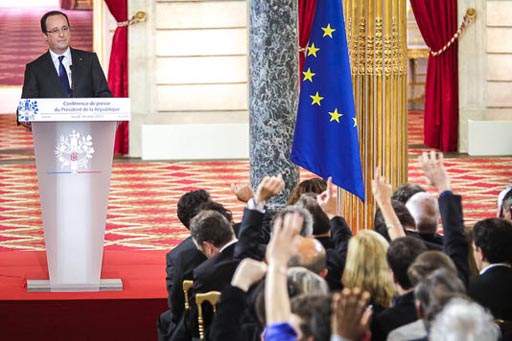
It should not pass without comment that, the day after the House of Commons tortured itself on the question of reducing the power of the EU, François Hollande was addressing 400 journalists in the Elysee Palace, to announce that he wanted to establish an economic government for the eurozone.

It almost goes without saying that British coverage of this has been slight and, with French media guarded by paywalls, one of the better reports comes from Die Welt. Hollande is under pressure, it says, the economy is limping, and the poll numbers are bad. And now he dares to rush forward and announce a Europe-wide campaign. 

This, incidentally, was the second major press conference of his term and it took two hours forty minutes for Hollande to entertain his audience of 400, plus his entire cabinet. 

Given continuously declining popularity ratings and depressing economic data, the expectations from Hollande's encounter was not just limited to the press, says DW. The unemployment rate has exceeded the previous record of three million, the European Commission has granted a two-year delay, so that France's budgetary objectives may be met by 2015 and, since the beginning of the week, the country has been officially in recession. 

This was confirmed after a meeting with the Commission last Wednesday, when Hollande admitted that growth in France would probably be zero. That would mean that he is not going to fulfil his most important promise - to reverse the trend in the labour market by the end of the year. Nevertheless, Hollande promised at his press conference that he would try everything to achieve a turnaround. 

It is against this background that, in the manner of a magician pulling a king-sized lapin out of le chapeau, Hollande decided to embark on his European adventure. 

Enter now Reuters which tells us that "European officials" gave a lukewarm response to president'slapin. Proposals for an "economic government" for the eurozone, complete with its own budget and a full-time president were, they say, not exactly nouveau, having been in circulation for some time. 

Since Hollande's "sweeping vision" also encompasses "a harmonised tax system" and "eurobonds", two ideas roundly rejected by the other half of the motor of integration, there is something of a suggestion that il se fout de ta gueule.

In two hours forty minutes, however, the president did manage a few soundbites of his own. "It is my responsibility as the leader of a founder member of the European Union ... to pull Europe out of this torpor that has gripped it, and to reduce people's disenchantment with it", he said. 

"If Europe stays in the state it is now, it could be the end of the project", he then said, before then dealing with the troublesome rosbifs. "Europe existed before Britain joined it", Hollande purred, only then to remark that, "I hope Britain stays in the European Union but I don't want to decide for the British".

That sounds suspiciously like, cela nous est complètement égal, but – to judge from the British coverage - we don't give a damn either. The grand gesture lives, says the BBC

But at least Hollande got one thing right. Opening the proceedings, he referred to his own unpopularity and told journalists that this, "was not a goal I set myself". One wonders what the French president might have achieved had he been really trying. 

COMMENT THREAD

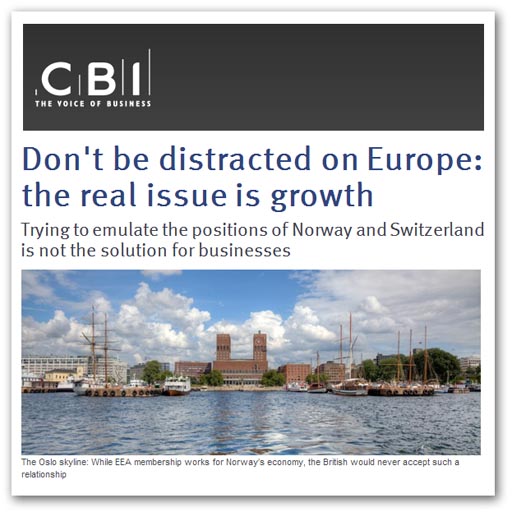
EU referendum: the "little Europeans" of the CBI

CBI 016-eur.jpg

There is some merit in dismissing the Conservative manoeuvres on the EU referendum as "gesture politics", as there is a huge element of showmanship in the current proposals. But therein also lies danger. The referendum has been moved up the political agenda and the possibility of there now being a poll on or before 2017 cannot be ruled out.

Certainly, the apparatchik currently heading the CBI, John Cridland, is not leaving things to chance. Already on the CBI blog and through the loss-making Guardian he is launching a counter-attack with a goodly dose of FUD (Fear-Uncertainty-Doubt), all in anticipation of a speech today to the British American Business Council. 

The intervention is helpful in that it reveals the tactics, with Cridland seeking to marginalise the EU issue by suggesting that other things are more important. But, in the FUD department, it is clear that the Norwegian and Swiss options worry them. 

Says Cridland, "Business has to make the nuts and bolts case for what our relationship with Europe should look like", then adding that: "Maintaining our influence to shape, and our access to, the Single Market will be central to that case".

The CBI pitch is that, "We have to focus on a positive vision of reform so Europe does less of the things we don't want, and more of the things we do: boosting competitiveness and resisting bad policies that work against growth and stability". 

This leads to the punchline as Cridland says: "Let's be clear. Being a member of a reformed EU is the best way to preserve market access". He goes on to say:
There are some who say that we could retain access to the Single Market without being a member of the EU; that the UK could withdraw and have a relationship with the EU more akin to Norway's or Switzerland's. I'd urge them to really look at the detail.

Norway's membership of the European Economic Area (EEA) – being outside the EU but part of the Single Market – means that it still pays the bills and follows the rules but has much lower influence on EU decision making than if it had a seat at the table.
There we have the "little European" talking, and the last thing he wants us to do is look at the detail. Cridland thus avoids any reference to the globalisation of regulation and standards, where increasingly rules for the Single Market are determined by international bodies working at a higher level than the EU. 

Nothing therefore is said about the fact that we are unrepresented on many of these bodies, as the EU takes our seat, while countries like Norway and Switzerland have direct representation and are shaping the rules to which we must conform. 

This dishonesty pervades the CBI case, with Cridland calling in aid the Norwegian Conservative MP, Nikolai Astrup, who has told the CBI: "If the UK wants to run Europe, it needs to be in Europe. If you want to be run by Europe, feel free to join us in the EEA".

"Taking rules without the power to influence them is certainly not my idea of much-touted greater sovereignty", says Cridland, neglecting to point out that Norwegian Conservatives are so keen to join the EU that they will do anything to denigrate the EEA. 

To an extent, this illustrates the scale of our problem. When it comes to the referendum campaign proper, Cridland, like Mr Cameron, has the easier job. They have no intentions of making the "positive case for Europe". Their strategy is to spray out the FUD, and tell only part of the story. It is left to us to tell people what has been missed out, and to complete the picture. 

In fact, neither EU nor EEA membership (outside of the EU) is entirely satisfactory, but as an interim measure, EEA membership keeps us in the Single Market, giving us time to work on a better deal. 

But the most important thing for British industry is to break out of the cloying grip of "little Europe" and to embrace the wider world. Sadly, you will not hear this from the CBI.

COMMENT THREAD

UK politics: Farage at bay

000FT 016-far.jpg

"We've never had this kind of reaction before", said the clearly taken-aback party leader as he was surrounded by protesters chanting often crude anti-UKIP slogans.

Scotland has always been difficult for Farage and, as he gets higher-profile, something like this was bound to happen. One wonders, though, whether the UKIP leader should have been better briefed, and whether he would have listened if he had been. 

COMMENT THREAD

EU politics: eurosceptic splits

000AFD 015-spl.jpg

DWN has been running a story about a power struggle that has broken out in the AFD, which has the potential to cause serious damage to the emergent party. And quick to intervene has beenHandelsblatt, with comment and readers' letters, while there is some further analysis on our own forum. 

Without dwelling specifically on the fate of the AFD, one can observe that this dynamic seems to be a characteristic of political groupings – witness the constant talk of "Tory splits". But this dynamic seems at its most virulent in the eurosceptic movement, which, as we have already remarked, increasingly resembles the Monty Python anti-Roman factions. 

Of the various groupuscules inhabiting the eurosceptic terrain, at this time there are perhaps as many factions as there are Pashtun tribes, each with their own fanatical adherents which make the People's Front of Judea look moderate. 

Factions are, in part, defined by their beliefs, and some of the more vitriolic adhere to the "trappist" doctrine – the belief that invoking Article 50 is a "trap" and that withdrawal from the EU should be occasioned only by the repeal of the European Communities Act and the unilateral abrogation of the treaties. 

These factions have recently been fortified by the support of convicted criminal and former MEP, Ashley Mote. He asserts that an unnamed "bureaucrat", of unspecified rank, location and employer, was "honest enough" to tell him personally that Article 50 is "about being told, after two years of discussions exclusively amongst the other members, what our terms of leaving would be". 

According to this anonymous official, as conveyed exclusively and uniquely by Ashley Mote, "we would then have to accept the EU's terms or withdraw the application to leave" – even though, in the absence of an agreement, the self-same Article 50 specifies that the Treaties shall cease to apply to the State in question … two years after the notification of withdrawal. 

Such an egregious misreading of the Article, however, does not detract from the religious fervour of the believers, who are given even more sustenance by the holiest of all cult leaders, Rodney Atkinson. He has recently handed down The Word from on high. 

Should, as a result of a referendum, the decision be to leave the European Union then the 1972 European [Communities] Act will be repealed, he has pronounced. Then, "the United Kingdom will leave the European Union and begin negotiations AS A SOVEREIGN UNENCUMBERED STATE to establish free trading and co-operation agreements with the EU together with other EEA States not part of the European Union". 

Thus, we are informed, the UK will not act under Article 50 of the Lisbon Treaty since the country will no longer be part of that constitutional Law. 

Quite what we are supposed to do by way of trade, in between the period of leaving and concluding negotiations to establish free trading and co-operation agreements, we are not told. But given that such negotiations – should the EU member states agree to them – could take some years, it is of more than academic interest. 

Nevertheless, what these tiny groupuscules think is generally of very little importance but for the tendency of the opposition to pluck them from their deserved obscurity and project their views as representing the eurosceptic community as a whole. 

The BBC is particularly adept at this technique, and nothing would serve the europhile cause better than to suggest that the alternative to staying in the EU is immediate, unilateral withdrawal, with all the uncertainty that that entails. The prospect of the chaos that would ensue is probably the best advert for staying in the EU that could be devised. 

Another reason why the "trappist" cult is dangerous is that it plays into the hands of the pretend eurosceptics, the so-called "europlastics" such as Rodney Leach. They belong to the rival "reformist" cult. 

The majority of the public, the political class and business, cultist Leach recently asserted, "are sceptical about the EU but rather than leaving it they want a new deal to reduce its power over their lives". And, high up in the list of reasons he uses to justify this assertion is the claim that none of the "outers" (recent or otherwise) has set out a credible alternative. 

Leach is very selective in order to make this claim, as there have been credible alternatives set out. These, he ignores, enabling him to cite the "trappists" in order to make his point. In his rivals, he has a ready-made alternative to condemn, one that completely lacks credibility. 

However, while Leach is quick to brand his rival cultists as lacking in credibility, his own plans miraculously escape a similar appellation. Yet, in the Leachate "new order", the EU is redefined as the Single Market, "not as a vague aspiration to political union, still less as a currency union". 

Safeguards, he then says, would be put in place to ensure that the eurozone did not write the rules for the rest of the member states, following which, "the next step would be to strengthen the powers of Westminster over EU decisions".

Here on this blog, we have been known to accuse the "trappists" of fantasy politics, going for what we have called the "magic wand" option. But Leach is in a league of his own. In a twinkling of an eye, he wants to reform away over sixty years of political integration, turning the EU into a cuddly free market. Then, for his next trick, he wants to weaken the primacy of EU law.

Supposedly, though, the "trappist" and "reformist" cults are both eurosceptics, sharing the same faith.  In theory, therefore - like the AFD - they should be united behind their common banner. But the reality is that, when there is such a yawning chasm between the different ideas, unity will always be a façade.

At the beginning, we saw in the AFD the elements of disharmony when they could not agree whether the euro should be abolished, or whether eurozone should just contract, to include only the northern European states.

With that much difference, there was never going to be harmony. And when British eurosceptic cults range from trappists to reformists, it is hard to concede that they even belong to the same religion. Their differences are not so much "splits" as the Grand Canyon on steroids.

Such cults, sharing only the tendency to indulge in fantasy politics, are never going to be united. But "split" is far too mild a word. They don't even inhabit the same universe.