EU referendum: the genie is out of the bottle

000Telegraph 013-bor.jpg

I rarely read the Boris Johnson effluvia, not least because I don't think a fully-paid up politician should have a column in a newspaper – or take money from newspapers. The media is supposed to be scrutinising politicians, not employing them.

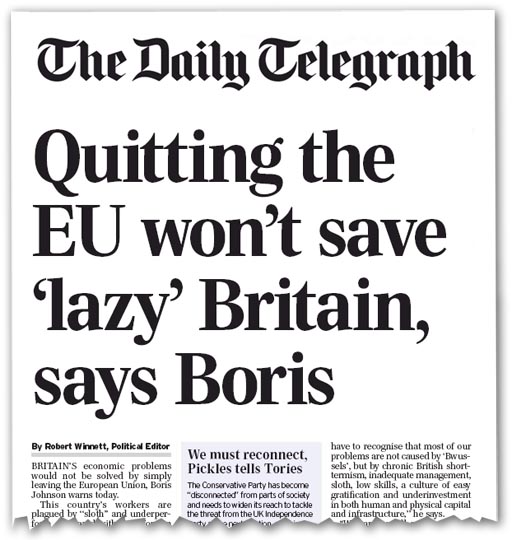
Even more bizarre is the practice of his employer taking his column, for which it has paid the man, and then treating it as news as a statement from "the London Mayor" (illustrated above). This is wrong. He was writing in his capacity as an employee of a business called the Telegraph Media Group Ltd. 

It also says very little for the news values of this business that it chooses to headline the claim by its employee that "this country's workers are plagued by 'sloth' and under-perform compared with their foreign rivals" – something which is dead easy to write when you are getting £250,000 a year for writing a crappy column for the Telegraph Media Group Ltd, on top of your Mayor's salary of £143,911 plus expenses (£11,445.93 last year). 

However, far more interesting – insofar as anything Johnson says is interesting – is the bit tucked in at the end of the news piece where we learn that The Great Man thinks that the EU will only take us seriously on renegotiation, "if they think we will invoke Article 50, and pull out, if we fail to get what we want".

Never mind that this dismal creature cannot actually think straight. If he was not too grand to read the Booker column, he could have learned that the only way to get what we want is to invoke Article 50. Like Samuel Johnson, who observed of a woman preaching that it was like a dog walking on his hind legs. "It is not done well; but you are surprised to find it done at all". So it is with Boris and Article 50. 

However, it is hugely entertaining to find that the groupescules are squeaking with rage at my references to Article 50, and have been particularly active this weekend in condemnation of Booker and myself, as well as polluting the Booker comments.

However, they are too late. The genie is out of the bottle, and we even have the loss-makingGuardian picking up the overpaid Boris and his reference to Article 50, while even John Redwood has discovered it and Farage has joined in the fun in the Daily Star.

Farage is accusing Mr Cameron of trying to obscure the truth of what would be involved if Britain was to leave the EU. He says that, under the terms of the Lisbon Treaty, a country wishing to withdraw had to action Article 50 of the treaty, which then provided for a two-year "period of grace" while negotiations took place. 

"He isn't haggling, he is wriggling," Farage says. "The Prime Minister is obscuring the truth. One can only imagine it is to fool his own backbenchers because it doesn't fool our friends on the Continent".

This has even made ITV News, which has former Conservative Cabinet minister Lord Forsyth adding to Cameron's disquiet, by saying that the prime minister is "wrong" to think he can renegotiate Britain's EU membership. 

"David Cameron is thinking he can persuade the golf club to play tennis, and his negotiating position is impossible because he is saying, 'If I don't succeed, I will continue to play golf'", Forsyth says. 

With the agencies also picking up the Farage quote, Article 50 is now spreading far and wide, even to be found in the Ellesmere Port Pioneer and (here's real fame for you), the Solihull News.

Despite all this, Mr Cameron, embarking on a three-day trip to the US, is complaining about people discussing a "hypothetical" referendum. There isn't going to be one tomorrow, he says, so, "What matters is making sure that we do everything we can to reform the EU, make it more flexible, more open, more competitive".

The poor man also wants to "improve Britain's relations with the EU, change those relations so that when we have the referendum before the end of 2017 we give the British public a real choice, a proper choice".

But the real choice, the proper choice, is Article 50, and it isn't going to go away. Much as the groupescules hate it, it is now part of the political discourse. 

COMMENT THREAD

EU politics: one treaty to cover them all

000FT 013-cha.jpg

Members of the German government have been blowing hot and cold on treaty change for so long now that it is difficult to know what to make of the thrust of their statements – especially as they often contradict each other.

Another complicating factor is the general election in September, so everything has to be seen through the filter of domestic politics – further complicated by the emergence of the AFD.

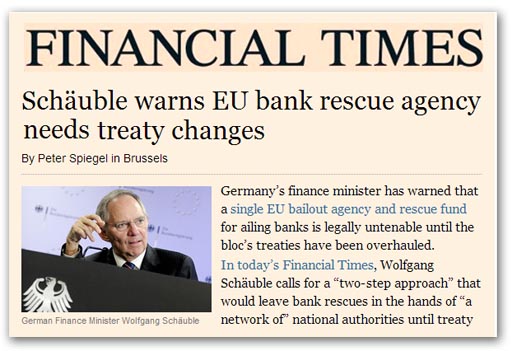
This time, though, it's our old friend, Wolfgang Schäuble and he isn't even talking to his home audience. Rather, he is in the Financial Times, perhaps speaking to a British audience, but perhaps not. 

Schäuble, we are told, is warning that a single EU bailout agency and rescue fund for ailing banks is legally untenable until a new treaty is on the block. The timing is interesting as we are just weeks away from a European Commission plan for a single bank resolution agency and rescue fund. 

This will be the second pillar in the eurozone's much-vaunted "banking union", but there is now some confusion about whether it can go ahead on schedule. 

Nevertheless, Schäuble is making his pitch, complaining – if that is the right word – that, "The EU does not have coercive means to enforce decisions", sinister words for someone close to the centre of German power. "Its historical roots are young", says Schäuble, then admitting, "Its democratic legitimacy could be improved upon".

In a more elliptical reference to the status of the EU, the German finance minister then adds, "What it has are responsibilities and powers defined by its treaties. To take them lightly, as is sometimes suggested, is to tamper with the rule of law".

What this suggests is that the limit if "treaty stretch" has been reached, and Schäuble is getting nervous about faking it. It may also be something to do with rumblings from the Bundesbank, and the continued unease at Draghi and his ECB stirring the euro pot, with his possible purchase of corporate loans, in breach of state funding rules. 

What usually happens next is that Merkel steps in and tells her finance minister to cool it – although the rebuke is rarely public, or direct. And then we enter another round of blowing hot and cold. 

Meanwhile, the signal will not have escaped Mr Cameron – or those of his advisors who can count to eleven without taking their socks off. They are looking for signs of an early treaty to hijack, and this could be the answer to a Conservative's prayer. 

At least the water should be nicely muddied as Mr Cameron grabs this lifeline to divert attention from his own growing disarray. 

However, Cameron should not get too excited. Schäuble is still talking of a banking union of sorts that can be had without revising the treaties, including a single supervisor; harmonised rules on capital requirements, resolution and deposit guarantees, and other trimmings. 

Using nice homely analogies, Schäuble calls this "a timber-framed, not a steel-framed, banking union". Ominously, he says this would serve its purpose and "buy time" for the creation of a legal base for "our long-term goal: a truly European and supranational banking union, with strong, central authorities". 

Even more ominously, perhaps explaining why he is talking to a British audience, he says this "legal base", aka treaty, could "potentially cover the entire single market". If that is the case, the British "referendum lock" kicks in. Be it Cameron or Miliband in a couple of year's time, we could still be having a referendum, this one on a new treaty. 

Let no one say that EU politics is ever boring. 

COMMENT THREAD

EU referendum: feeding frenzy

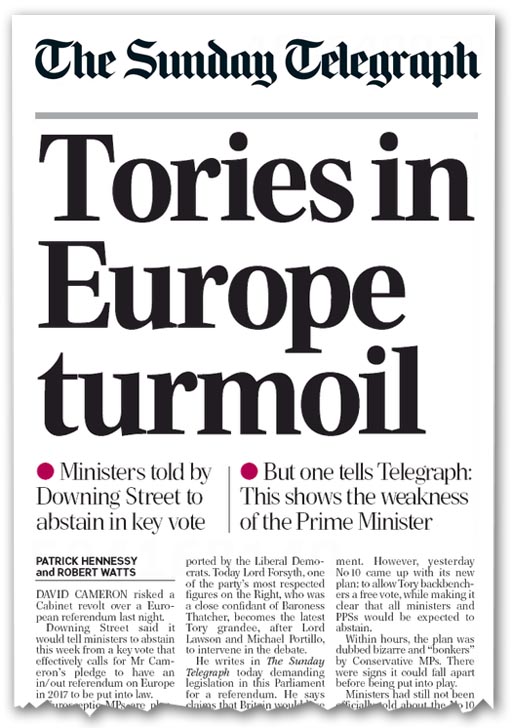
000Telegraph 012-tur.jpg

Entirely typical of the Fourth Estate, the media is turning the serious question of our continued membership of the EU into a biff-bam, soap-opera style contest, centring on a putative "commons revolt" which may or may no occur some time this coming week.

Particularly prominent in this low-grade game are the two Sunday "heavies", the Sunday Times and the Sunday Telegraph, both of which offer front-page headlines relating to Tory "revolts" or "civil war".

The latest development in this saga is Michael Gove declaring that he would vote for Britain to exit Europe if there was a referendum tomorrow. 

Fortunately, there won't be a referendum tomorrow. The Times YouGov poll earlier this week (published Wednesday) had 35 percent wanting to stay in the EU, with 46 percent leaving and 20 percent "don't knows". This isn't anything like a big enough margin to ensure victory. 

The big problem with all the hyperventilation, though, is that it is not leading to any better appreciation of the problems of leaving the EU, and nor is it leading to any change in Tory strategy, which remains one of attempting to renegotiate the treaties. Thus, to have 100 or so Tory "rebels" calling for a referendum, without the first idea of how they are going to win it (assuming they do want to leave the EU), is not exactly helpful. 

Neither is the official Tory response, which is to have "strategy" chief Lyton Crosby calling for the date of an EU referendum to be brought forward a year early from the planned 2017. 

This simply means leaping over the edge of the cliff a year earlier than anticipated, as we confront a referendum that is difficult to win and which risks serious damage to the eurosceptic cause. 

On the other hand, we have Ed Miliband who is taking on the mantle of a rock of stability, refusing to countenance a referendum, and maintaining a staunch pro-EU position. 

If the Kellner view is accepted, and we are likely to lose a referendum which gives the choice between a "renegotiated" settlement and leaving, then the best option for avoiding electoral defeat is increasingly looking to be Labour. Those who can't go that far should simply vote UKIP – especially in Tory-Labour marginals - as the next best thing. 

Completely oblivious to the adverse effect of his manoeuvring, however, John Baron still pursues the idea of "paving legislation", to convince the electorate that Mr Cameron is serious in his intention to hold a referendum. 

But thereby, he misses the point. The referendum is just a means to an end, and if it is to be manipulated by a Conservative prime minister – should the party gain office – there is no real point in having one. It most certainly will not convince the hard-core "outers" that they should vote Conservative. 

Sadly, therefore, with the aid of the media, all be are getting is a huge confusion between activity and outcome. The referendum soap opera may keep the hacks entertained, as they indulge in their feeding frenzy, but withdrawal from the EU is no closer than it has ever been. 

COMMENT THREAD

What has"econophysics" achieved?


Research in so-called "econophysics" -- the application of ideas and concepts from physics to problems in finance and economics -- tends to be quite controversial. Many economists in particular seem to find it fairly annoying, although quite a few others either work in the area or do work that is closely associated in conceptual terms. Physicists in the area have been criticized on various occasions for being ignorant of prior work in economics (sometimes true), of using less than rigorous statistics (I haven't seen anything convincing on this) and of employing unrealistic models.

There is plenty of uninspiring work in the field, as in any area of science. Out of politeness, and to avoid boring anyone, I won't make a list. But physicists have made quite a number of lasting contributions to a deeper understanding of finance and economics; in some cases, I think, they have helped to change the direction of research in economics. So I thought it might be worth making a short list of the things that I think have indeed been success stories. Here goes:

1. More than anything, physicists have helped to establish empirical facts about financial markets; for example, that the probability of large market returns decreases in accordance with an inverse cubic power law in many diverse markets. This seems to be a universal result, at least approximately. I've written about this work here. Work by physicists has also established other generic market patterns such as the self-similar structure of market volatility. I very nice review of these patterns is this one by Lisa Borland and colleagues.

Now, did econophysicists initiate this kind of work? Of course not. Benoit Mandelbrot found the first evidence for fat tailed distributions in the early 1960s (and Eugene Fama even wrote about that work in his first paper!). But research by physicists has made our knowledge of these empirical regularities much more precise.

2. Physicists have also identified instructive links between markets and other natural phenomena. For example, in the period following a large market crash, markets show lingering activity which follows the famous Omori law for earthquake aftershocks (events become less likely in simple inverse proportion to the time after the main shock). Such connections indicate that the explanation of such market dynamics may well not depend on facts specific to finance and economics; that more general dynamical principles may be involved.

3. Physicists have also helped develop more realistic models of markets, here mostly in collaboration with economists. In the mid-1990s, researchers at the Santa Fe Institute first demonstrated how fat-tailed dynamics could arise naturally in models representing a market as an ecology of interacting adaptive agents. Models of this kind have since become widespread and used to perform some of the most sophisticated tests of policy proposals -- for the idea of a financial transactions tax, for example, as currently planned by the European Commission. For this, econophysics deserves some credit. For a nice review, see this paper by economist Blake Lebaron (I've summarized it here). 

If you doubt that the early work at Sante Fe had a real effect on encouraging this work, pushing the study of computational models of heterogeneous adaptive interacting agents to the forefront of market modelling, take a look at this 2002 review by economist Cars Hommes. As seminal work in this area, he cites papers in the early 1990s by Alan Kirman, by Brad DeLong and colleagues and by the group at Santa Fe which involved a key collaboration between economists and physicists. This work helped kick off, as he describes it, a transformation (still ongoing) of style in modelling markets:
In the past two decades economics has witnessed an important paradigmatic change: a shift from a rational representative agent analytically tractable model of the economy to a boundedly rational, heterogeneous agents computationally oriented evolutionary framework. This change has at least three closely related aspects: (i) from representative agent to heterogeneous agent systems; (ii) from full rationality to bounded rationality; and (iii) from a mainly analytical to a more computational approach...
Hommes makes it sound here as if this transformation and paradigm shift is now widely accepted in economics. I'm not so sure about that as there still seem to be plenty of people eagerly working away on rational representative agent models.

4. Work in econophysics -- through the study of minimal models such as the minority game -- has also revealed surprising qualitative features of markets; for example, that a key determinant of market dynamics is the diversity of participants' strategic behaviour. Markets work fairly smoothly if participants act using many diverse strategies, but break down if many traders chase few opportunities and use similar strategies to do so. Strategic crowding of this kind can cause an abrupt phase transition from smooth behaviour into a regime prone to sharp, virtually discontinuous price movements. 

If this point seems esoteric, one fairly recent study found more than 18,000 instances over five years where a stock price rose or fell by roughly 1% or more in well under a tenth of a second. These "glitches" or "fractures" may signal a transition of markets into a regime dominated by fast algorithmic trading. As algorithms compete on speed, they naturally rely on simple strategies, which encourages strategic crowding. The underlying phase transition phenomenon may therefore be quite relevant to policy. I know of nothing in traditional economic analysis that describes this kind of phase transition or does anything to elucidate the kinds of conditions under which it might take place.

5. Yale economist John Geanakoplos has argued for two decades that a key variable driving major economic booms and busts is the amount of leverage used by financial institutions. It goes up in good times, down in bad. Since the financial crisis, controlling leverage has become a major new focus of financial regulators, and their work may well benefit from physics-inspired models of the dynamics of markets in which firms compete with one another through the use of leverage. A notable study by Geanakoplos and two physicists found that such a market will naturally become unstable as leverage increases beyond a threshold. This boundary of instability is not at all obvious to market participants or made evident by standard economic theories. Such models may well help improve macroeconomic policy and financial regulation (I've written a little more on this here).

6. Physicists have also helped clarify other fundamental sources of market instability. For example, standard thinking in economics holds that the sharing of risks between financial institutions -- through derivatives and other instruments -- should both make individual firms safer and the entire banking system more stable. However, a collaboration of economists and physicists recently showed that too much risk sharing in a network of institutions can decrease stability. (Some discussion of this work here.) An over-connected network makes it too easy for trouble originating in one place to spread elsewhere. Again, this work involves an important collaboration between economists and physicists.

7. On a similar theme, fundamental analysis by econophysicists has examined the relationship between market efficiency and stability. In economic theory, markets become more efficient -- more able to pool collective wisdom and price assets accurately -- as they become more "complete," i.e. equipped with such a broad range of financial instruments that essentially any trade can be undertaken. The econophysics work has shown, however, that completeness brings with it inherent market instability, a possibility never raised (to my knowledge) by standard economic analyses.

8. The complexity of today’s markets makes is essentially impossible for financial institutions to judge the risks they face, as the health of any decent-sized financial institution depends on a vast web of links to other institutions about which little may be known. To improve risk judgement, econophysicists have recently developed a network measure called DebtRank which aims to cut through network complexity and reveal the true riskyness of any particular institution. This idea may also provide a natural means for making markets more stable, for if regulators made DebtRank results public, then anyone would, at a glance, gain a much more accurate view of the true risks associated with any bank. If banks seeking to borrow funds were forced to do so from the least risky banks, systemic instability would be improved. This is, for now, a highly speculative idea, but one that clearly has promise.

So there -- a list of 8 specific areas where I think econophysics has had an important impact on economics and finance. This is, as I said, a very short list, and of course reflects only my limited view. It also reflects limitations on how much I can write in one sitting, as there are clearly other notable achievements such as recent theories of market impact -- here and here, for example -- which make significant steps toward explaining how much prices change when someone sells an asset. I haven't mentioned applications of random matrix theory which cast serious doubt over how much empirical calculations of stock correlations really imply about the true correlations between those assets (undermining Markowitz portfolio theory). Then there's an entire field of work exploring how firm growth rates scale with firm size and what might account for this.

All of which suggests, to my mind, that econophysics has been a very valuable development indeed.
TO NDC OR NOT TO NDC? THAT REALLY IS THE QUESTION


Not since APD has a three letter acronym caused such a stir in the business travel industry. And those three letters? N, D and C, of course.


New Distribution Capability is a new business model proposed by IATA member airlines that – if approved by the US Department of Transport – will allow greater visibility of the airlines’ products at point of sale. Seats will no longer be distinguishable purely by price and carrier alone. Consumers will be able to compare class, seat type, service levels and ancillary costs, as well, in the same way that hotels are sourced and booked.   

The introduction of greater visibility means that airlines will no longer compete on price and brand awareness, but rather on a more accurate like-for-like product basis. The travel industry understands the need for this change and agrees it is a good thing for the airline industry, the manager and the consumer.

However, the NDC proposition is also stirring up a cloud of controversy in the travel industry. Why? For two reasons. Firstly, IATA has excluded travel managers, travel agencies and trade organisations from strategy meetings. And secondly, because the new technology gives airlines the capability to ask buyers to input demographic passenger profiles pre-search.

All airlines already hold extensive amounts of passenger data, which is used in targeted marketing campaigns, competitive intelligence and to establish the viability of new routes, which is essential for opening up emerging markets.

But none asks for that information pre-search. Doing this means the airlines could – note, not would – discriminate based on the pre-search data, raise prices artificially and charge higher prices to those travellers they feel are able to pay more: corporates. And in a time when managing costs is still very high on the travel managers’ agenda, the possibility of paying more – and artificially so – is understandably grating.

By David Chapple

David Chapple is event director of the Business Travel Show, which takes place each February in London. Find out more at www.businesstravelshow.com. Comment on this blog below, or contact David on Twitter @btshowlondon 

You do live on another planet -- evidence from the SEC

It seems that famed hedge fund manager Philip Falcone has, in principle, agreed to terms with the SEC in the case in which he was accused of "manipulating the market, using hedge fund assets to pay his taxes and “secretly” favoring select customers at the expense of others." Not surprisingly, as this is the SEC we're talking about, the agreement included the usual weasel clause letting the defendant admit no guilt. But it gets even better.

If you want evidence that the SEC was really determined to bend over backward on this one, how about the fact that the agreement didn't even include the usual statement, by the defendant, not to commit fraud in the future:
The settlement deal... is also notable for something that it did not include: a common provision that prohibits defendants from committing future violations with fraudulent intent. The lack of a so-called fraud injunction is an unusual victory for the target of an S.E.C. action.    
You may wonder why it even makes sense to include a clause prohibiting a defendant from committing future fraudulent acts, as fraud is already illegal. And just being a citizen essentially means you've agreed to it. Apparently, this clause makes it easier to prosecute future cases (the court can hold the defendant in contempt of court, at least in principle, for violating the law even after telling the court that he wouldn't). But here we have the SEC going to extra lengths not to make Mr. Falcone make such a terrible promise.

Questioning conventional wisdom

I recommend this fascinating interview with Harvard development economist Dani Rodrik. In his own words, he is someone who has worked from within the economic mainstream (especially where methods are concerned) but has not been afraid to accept logical conclusions that go against conventional wisdom, which is often not actually supported by any logic or theory. As he says,
...where I tend to part company with many of my colleagues is with the policy conclusions I reach. Many of my colleagues think of me as excessively dirigiste, or perhaps anti-market. A colleague at Harvard’s Economics Department would greet me by saying “how is the revolution going?” every time he saw me. A peculiar deformation of mainstream economics is the tendency to pooh-pooh the real-world relevance of all the theoretical reasons market fail and government intervention is desirable.
This sometimes reaches comical proportions. You get trade theorists who have built their entire careers on “anomalous” results who are at the same time the greatest defenders of free trade. You get growth and development economists whose stock in trade are models with externalities of all kinds who are stern advocates of the Washington Consensus. When you question these policy conclusions, you typically get a lot of hand-waving. Well, the government is corrupt and in the pockets of rent-seekers. It does not have enough information to undertake the right kinds of interventions anyhow. Somehow, the minds of these analytically sophisticated thinkers turn into mush when they are forced to take seriously the policy implications of their own models.
This is an interesting point. In essence, he is suggesting that some of the policy conclusions generally supported by the economic mainstream (deregulation, more markets, etc.) actually find no real foundation in theory. Yet many economists support these conclusions anyway for other reasons. He goes on to talk about the social forces within the profession:
There are powerful forces having to do with the sociology of the profession and the socialization process that tend to push economists to think alike. Most economists start graduate school not having spent much time thinking about social problems or having studied much else besides math and economics. The incentive and hierarchy systems tend to reward those with the technical skills rather than interesting questions or research agendas. An in-group versus out-group mentality develops rather early on that pits economists against other social scientists. All economists tend to imbue a set of values that tends to glorify the market and demonize public action.
What probably stands out with mainstream economists is their awe of the power of markets and their belief that the market logic will eventually vanquish whatever obstacle is placed on its path. As a result, economists tend to look down on other social scientists, as those distant, less competent cousins who may ask interesting questions sometimes but never get the answers right. Or, if their answers are right, they are so not for the methodologically correct reasons. Even economists who come from different intellectual traditions are typically treated as “not real economists” or “not serious economists.”
So the hurdles for the economists that want to depart from the conventional path are pretty high. Above all, they must play by the methodological rules of the profession. That means using the language of mathematics, the standard optimizing, general-equilibrium frameworks, and the established econometric tools. They must pay their dues and demonstrate they remain card-carrying members in good standing.
Now, Rodrik does suggest that he likes to work within this framework for various reasons. But what he then says is most interesting, touching back on the point of how widely held policy views link back to actual economic theory. Often, he suggests, they have no foundation at all in such theory, which is often employed more as a rhetorical tool than anything else:
In my own case, every piece of conventional wisdom I challenged had already become a caricature of what sounds economics teaches us. I wasn’t doing anything more than reminding my colleagues about standard economic theory and empirics. It was like pushing on an open door. I wasn’t challenging the economics, but the sociology of the profession. For example, when I first began to criticize the Washington Consensus, I thought I was doing the obvious. The simple rules-of-thumb around which the Consensus revolved had no counterpart in serious welfare economics. Neither were they empirically well supported, in view of East Asia’s experience with heterodox economic models. When you questioned supporters closely, you first got some very partial economic arguments as response, and then as a last resort some political hand-waving (e.g., “we need to get the government to stop doing such things, otherwise rent-seeking will be rife…”). My argument was that we should take economics (and political economy) more seriously than simply as rules of thumb. Economics teaches us to think in conditional terms: different remedies are required by different constraints. That way of thinking naturally leads us to a contextual type of policy-making, a diagnostic approach rather than a blueprint, kitchen-sink approach.
Similarly, when I questioned some of the excessive claims on the benefits of globalization I was simply reminding the profession what economics teaches. Take for example the relationship between the gains from trade and the distributive implications of trade. To this day, there is a tendency in the profession to overstate the first while minimizing the second. This makes globalization look a lot better: it’s all net gains and very little distributional costs. Yet look at the basic models of trade theory and comparative advantage we teach in the classroom and you can see that the net gains and the magnitudes of redistribution are directly linked in most of these models. The larger the net gains, the larger the redistribution. After all, the gains in productive efficiency derive from structural change, which is a process that inherently creates gainers (expanding sectors and the factors employed therein) and losers (contracting sectors and the factors employed therein). It is nonsensical to argue that the gains are large while the amount of redistribution is small – at least in the context of the standard models. Moreover, as trade becomes freer, the ratio of redistribution to net gains rises. Ultimately, trying to reap the last few dollars of efficiency gain comes at the “cost” of significant redistribution of income. Again, standard economics.
Saying all this doesn’t necessarily make you very popular right away. I remember well the reception I got when I presented my paper (with Francisco Rodriguez) on the empirics of trade policy and growth. The literature had filled up with extravagant claims about the effect of trade liberalization on economic growth. What we showed in our paper is that the research to date could not support those claims. Neither the theoretical nor empirical literature indicated there is a robust, predictable, and quantitatively large effect of trade liberalization on growth. We were simply stating what any well-trained economist should have known. Nevertheless, the paper was highly controversial. One of my Harvard colleagues asked me in the Q&A session: “why are you doing this?” It was a stunning question. It was as if knowledge of a certain kind was dangerous.
Years earlier, when I wrote my monograph Has Globalization Gone Too Far? I had been surprised at some of the reaction along similar lines. I expected of course that many policy advocates would be hostile. But my arguments were, or so I thought, based solidly on economic theory and reasoning. A distinguished economist wrote back saying “you are giving ammunition to the barbarians.” In other words, I had to exercise self-censorship lest my arguments were used by protectionists! The immediate qestion I had was why this economist thought barbarians were only on one side of the debate. Was he unaware of how, for example, multinational firms hijacked pro-free trade arguments to lobby for agreements – such as intellectual property – that had nothing to do with free trade? Why was it that the “barbarians” on one side of the issue were inherently more dangerous than the “barbarians” on the other side?
But ultimately, the reward of challenging conventional wisdom that has gone too far is that you are eventually proved right. The Washington Consensus is essentially dead, replaced by a much more humble approach that recognizes the importance of locally binding constraints. And many of the arguments I made about the contingent nature of the benefits from trade and financial globalization are much closer to the intellectual mainstream today than they were at the time.